
Articles ·
Corrales vs Castillo I: my favourite fight of all time
A personal remembrance of Diego Corrales vs José Luis Castillo, its impossible tenth round and the vanished Showtime era that framed it.
There are better displays of boxing technique. There are more historically important fights, bigger crowds and much bigger names. There may even have been more dramatic single rounds, although I would need some convincing on that one.
But if somebody asks me to name my favourite fight, I never have to think about the answer. It is Diego Corrales against José Luis Castillo, the first one, at Mandalay Bay on 7 May 2005.
It has been 21 years and I have watched it more times than I could possibly count. I know what is coming. I know the shifts in momentum, the damage slowly accumulating around Corrales's eyes and every beat of that ridiculous tenth round. None of that seems to matter. Each time, somewhere in the middle of it, I find myself pulled back in and hoping the fight will somehow end differently from the way I know it does.
Not because I want a different winner. I just do not want it to end.
Before the miracle
The fight is now remembered almost entirely for its final two minutes. That is understandable. The tenth round contains enough incident for an entire career. Taken on its own, it is probably the most dramatic round in boxing history.
But reducing Corrales–Castillo to its ending does both men a disservice. The first nine rounds are extraordinary.
Corrales was the taller man and an excellent boxer at range. He could have tried to make his height and reach the story of the fight. Instead, he stood in front of perhaps the best inside fighter of his generation and went to work. Castillo did what Castillo always did: edged forward, took away space and dug short punches into anything available. Arms, ribs, chin. Corrales met him there.
Neither man fought recklessly. That is part of what makes the violence so compelling. Watch closely and there is beautiful craft everywhere: shoulders creating inches of room, forearms controlling position, short uppercuts threaded through tiny gaps and body punches changing the shape of the next exchange. They were not simply taking turns hitting one another. They were solving and then immediately creating problems at a frightening pace.
The rounds are close without being vague. Each has its own rhythm. Castillo's pressure begins to tell, Corrales answers with the cleaner combination, and then Castillo finds the body again. At the end of nine, the judges were divided: Corrales led 87-84 and 86-85 on two cards, while Castillo led 87-84 on the third. That feels right. The only thing everyone could agree on was that they were watching something special.
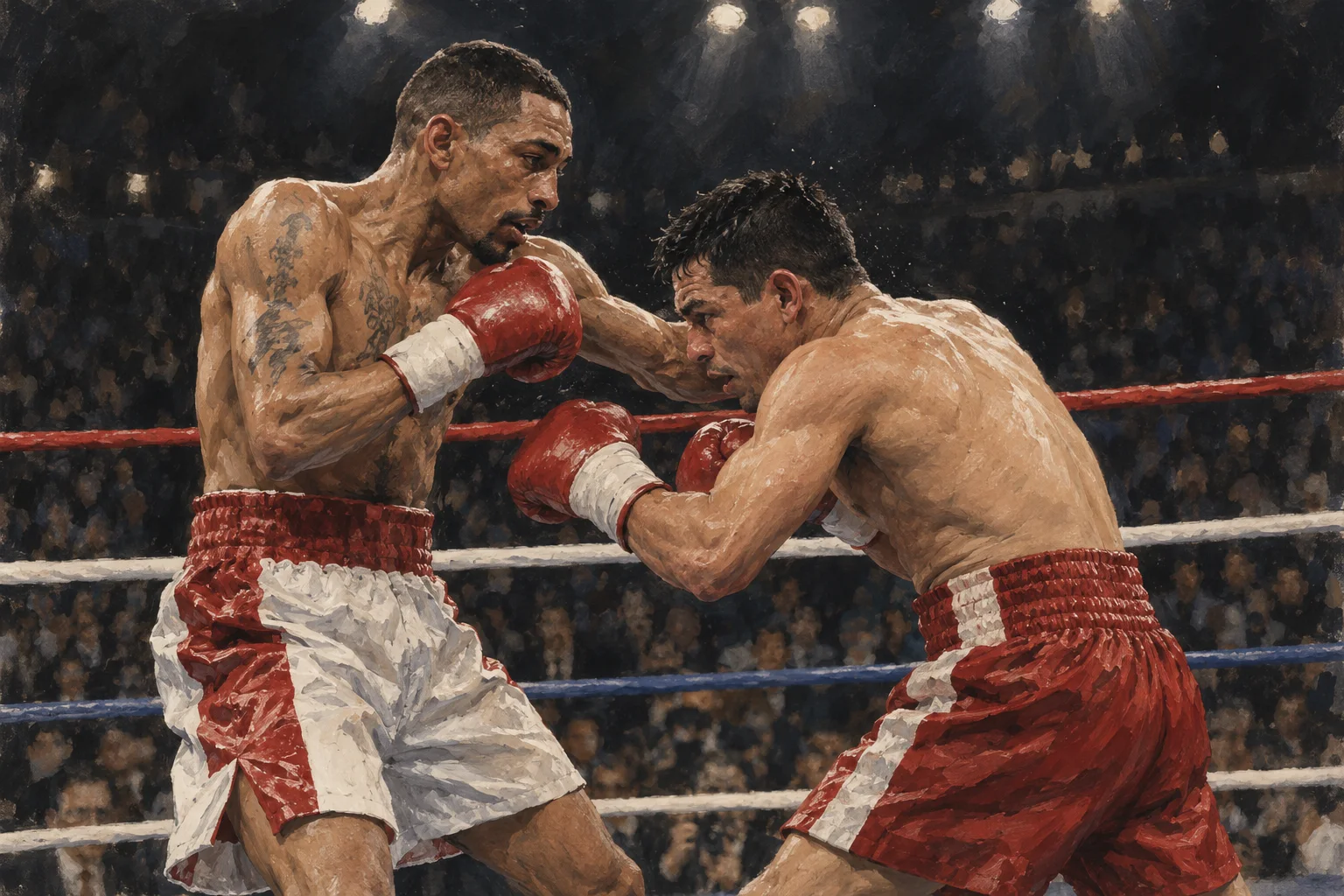
Corrales and Castillo meet at close range. Original editorial illustration created for Fight Scores.
The tenth
Twenty-five seconds into the tenth round, Castillo landed the left hook he had been threatening all night. Corrales went down heavily and his mouthpiece came out. He made it to his feet, bought precious seconds while the mouthpiece was replaced, and was sent back into the fight.
Castillo dropped him again moments later. This time there was no ambiguity about the mouthpiece. Corrales removed it, referee Tony Weeks deducted a point and Joe Goossen delivered the most famous corner instruction of his career: “You gotta fucking get inside on him now.”
It sounds absurd. Corrales had just been knocked down twice by one of boxing's great inside fighters. He was hurt, his face was swollen and, with the point deduction, he was staring at a 10-6 round. Goossen told him to go back into the fire.
So he did.
Corrales caught Castillo with a right hand. Then a left hook. Suddenly Castillo, who seconds earlier had been on the verge of victory, was the one looking for space. Corrales drove him to the ropes and continued punching until Weeks stepped between them at 2:06.
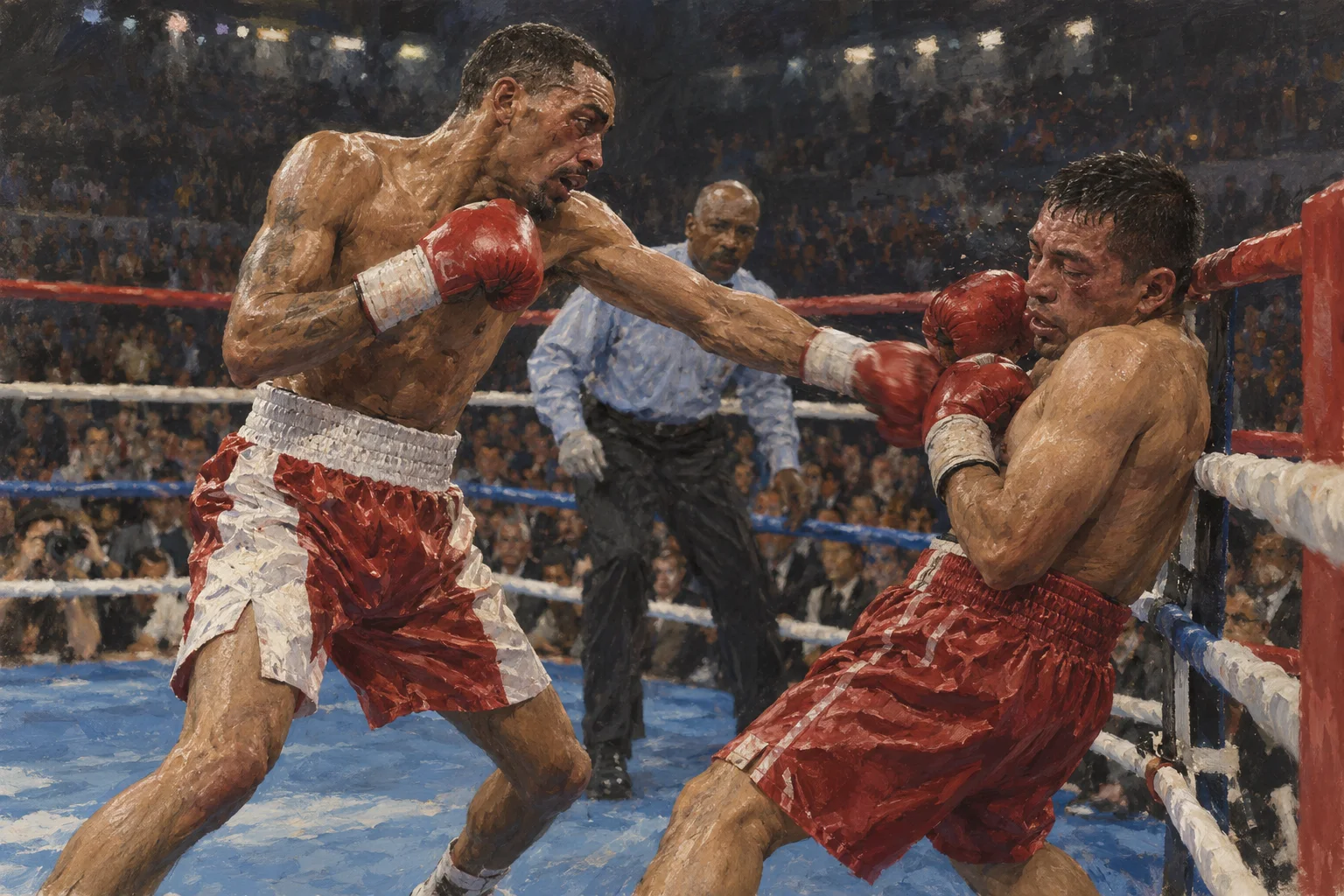
Corrales turns the tenth round around. Original editorial illustration created for Fight Scores.
I can describe it, but the description never quite makes sense. It remains one of those rare sporting moments where the sequence of events feels less believable every time you see it. Corrales appears finished, receives one last instruction and then changes the entire fight before anybody has time to understand what is happening.
The mouthpiece will always be part of the conversation. It bought Corrales recovery time and the second removal was plainly deliberate. The point deduction followed the rules, but Castillo had every reason to feel aggrieved. I do not think acknowledging that diminishes what came next. Corrales still had to stand up, walk back towards the man who had just flattened him twice and produce the punches to stop him. Gamesmanship created an opportunity; courage and astonishing execution turned it into something immortal.
A Showtime fight
When I return to the fight now, I am nostalgic for more than the two men in the ring. I miss the entire frame around them.
The Showtime presentation is inseparable from my memory of Corrales–Castillo. The graphics, the lighting, Jimmy Lennon Jr. in the centre of the ring and that commentary team allowing the fight to breathe. It looked and sounded like a big fight without constantly needing to tell you that it was one. There was polish, but there was also restraint. The boxers were the event.
That may sound like an old boxing fan complaining that everything was better in the past. It was not. Boxing in 2005 contained all the same frustrations it does now: politics, fragmented titles, bad judging, mismatches and fights that arrived too late. Nostalgia has a habit of editing those things out.
Still, something has been lost. Showtime broadcast boxing for 37 years before airing its final card in December 2023. HBO had already left the sport. Between them, those networks gave generations of fans a familiar place where boxing lived. A Saturday-night fight did not feel like another piece of content in a scrolling interface. It had a beginning, a voice and a sense of occasion.
Corrales–Castillo belongs to that world. Even the slightly softened standard-definition picture now feels right. Watching it in 2026 is like opening a box containing something you had forgotten you owned. The sport is still recognisable, but the atmosphere around it has disappeared.
Two years later
The story became more complicated almost immediately.
Castillo won their rematch five months later, knocking Corrales out in the fourth round after failing to make the lightweight limit. A third fight was arranged and then abandoned when Castillo missed weight again. What should have become a defining trilogy never received its final chapter.
Then, on 7 May 2007, exactly two years after the first fight, Diego Corrales died in a motorcycle accident in Las Vegas. He was 29.
That knowledge changes a rewatch. It is impossible not to see something of Corrales himself in the way the first fight ends: vulnerable and defiant, making a decision that seems completely unreasonable from the outside and committing to it without reservation. I am wary of turning real people into neat sporting metaphors, particularly after they are gone, but it is difficult to separate the fighter from that moment.
Castillo deserves equal reverence. His role is sometimes reduced to being the man on the wrong end of Corrales's comeback. In reality he was magnificent. He imposed the fight, absorbed an appalling amount of punishment and came within seconds of winning it. The fight could not exist without his composure, pressure and willingness to remain in exchanges that most boxers would have escaped.
This was not one man producing greatness while another happened to be present. They made it together.
Why it is still my favourite
The phrase “fight of the year” is useful but inadequate. We hand it out annually because the calendar requires a winner. Corrales–Castillo was named the best fight of 2005 by The Ring and the Boxing Writers Association of America, but it escaped that category almost immediately. It became one of the contests against which every subsequent great fight is measured.
For me, though, its importance is more personal than any ranking.
It contains everything I love about boxing and much of what makes the sport difficult to love. There is skill that becomes clearer with every rewatch, courage that borders on self-destruction, controversy that will never be completely resolved and an ending no sensible writer would dare invent. It is beautiful and uncomfortable at the same time.
Most of all, it reminds me why I became absorbed by this strange sport in the first place. Boxing can frustrate you for months and then, without warning, produce a few minutes that no other sport could create. Corrales and Castillo gave us ten rounds like that. Showtime captured them. We are incredibly fortunate that we can still go back.
I do not know whether it is the greatest fight of all time. I am increasingly less interested in trying to prove those things. I only know that it is my favourite, and after 21 years nothing has come particularly close.
You can score Corrales vs Castillo round by round on Fight Scores. Just do not be surprised if, somewhere around round eight, you forget you were meant to be keeping score.